Sunday, September 30, 2018

September 30, 2018
One Hundred Ways to Get to 100
Posted by: Patrick Kenny


Title: One Hundred Ways to Get to 100
Author: Jerry Pallotta
Illustrator: Rob Bolster
Recommended Grade Level: 1-3

Common Core Mathematics Standard:
1.NBT.C.4
Add within 100, including adding a two-digit number and a one-digit number, and adding a two-digit number and a multiple of 10, using concrete models or drawings and strategies based on place value, properties of operations, and/or the relationship between addition and subtraction; relate the strategy to a written method and explain the reasoning used. Understand that in adding two-digit numbers, one adds tens and tens, ones and ones; and sometimes it is necessary to compose a ten.
2.OA.A.1
Use addition and subtraction within 100 to solve one- and two-step word problems involving situations of adding to, taking from, putting together, taking apart, and comparing, with unknowns in all positions, e.g., by using drawings and equations with a symbol for the unknown number to represent the problem.

Common Core Standard for Mathematical Practice
CCSS.Math.Practice MP1 Make sense of problems and persevere in solving them.

Summary: This book is a counting book that helps young mathematicians count to 100. It uses basic counting by ones as well as skip counting by 2’s, 5’s, 10’s and 20’s. It also includes some multiplication examples on how to get to 100. The book also contains division and addition problems, all totalling 100.
Rating: *****  I highly recommend this book for young mathematicians as it helps them find numerous ways to count to 100.
Classroom Ideas: This book can be used in a variety of ways and used with numerous math problems. It includes addition, subtraction, multiplication and division. It shows plenty of different ways to get to 100. Students can use this to help them add any number(s) that they find throughout the classroom and help them add them together.


The Very Hungry Caterpillar Posted by: Bria Gayle

The Very Hungry Caterpillar 
Posted by: Bria Gayle


Title: The Very Hungry Caterpillar
Author and Illustrator: Eric Carle
Recommended Grade Level: Pre-kindergarten – 1st grade
Common Core Mathematics Standard:
CCSS.MATH.CONTENT.K.CC.A.3
Write numbers from 0 to 20. Represent a number of objects with a written numeral 0-20 (with 0 representing a count of no objects).
CCSS.MATH.CONTENT.K.CC.B.4
Understand the relationship between numbers and quantities; connect counting to cardinality.
CCSS.MATH.CONTENT.K.CC.C.6
Identify whether the number of objects in one group is greater than, less than, or equal to the number of objects in another group, e.g., by using matching and counting strategies.1

Common Core Standards for Mathematical Practice:
CCSS.MATH.PRACTICE.MP4 Model with mathematics.
Summary: This story is about the life cycle of a caterpillar as it starts by coming out of its egg, all the way to becoming a butterfly.  He eats his way through several kinds of fruit and food.  For example on Monday he eats through an apple, on Tuesday two pears, on Wednesday three plums, and so on.  However, after eating all these fruits during the week he was still hungry.  By Saturday, he eats a bunch of human food and it gives him a stomachache.  On Sunday, he eats a green leaf making him feel better.  He builds a cocoon and eats his way out turning into a butterfly.
Rating: ***** I highly recommend this book.  It covers the life cycle of a butterfly from an egg.  Also covers the days of the week, colors, counting, and healthy eating.  This book has been a classic for years.
Classroom Ideas: Students can count out the foods that the caterpillar eats each weekday.  Teachers can give out visuals of the fruits and have them come up and place the fruits on a chart.  Then ask the students, how many things does he eat on Thursday?  How many more things did he eat on Wednesday than Thursday?  How many fruits in total?  This is where addition comes into play.  They can identify the days of the week and count how many days in a week.  They can also use math manipulatives on the table while the story is being read aloud. Lastly, students can act out and represent each food and do a count off.


Saturday, September 29, 2018

The Very Hungry Caterpillar


Title: The Very Hungry Caterpillar
Author and Illustrator: Eric Carle
Recommended Grade Level: Kindergarten

Common Core Mathematics Standard:

CCSS.MATH.CONTENT.K.OA.A.1
Represent addition and subtraction with objects, fingers, mental images, drawings1, sounds (e.g., claps), acting out situations, verbal explanations, expressions, or equations.

CCSS.MATH.CONTENT.K.CC.A.3
Write numbers from 0 to 20. Represent a number of objects with a written numeral 0-20 (with 0 representing a count of no objects).

CCSS.MATH.CONTENT.K.CC.A.2
Count forward beginning from a given number within the known sequence (instead of having to begin at 1).


Common Core Standards for Mathematical Practice:

Model with mathematics.

CCSS.MATH.PRACTICE.MP4 

Mathematically proficient students can apply the mathematics they know to solve problems arising in everyday life, society, and the workplace. In early grades, this might be as simple as writing an addition equation to describe a situation. In middle grades, a student might apply proportional reasoning to plan a school event or analyze a problem in the community. By high school, a student might use geometry to solve a design problem or use a function to describe how one quantity of interest depends on another. Mathematically proficient students who can apply what they know are comfortable making assumptions and approximations to simplify a complicated situation, realizing that these may need revision later. They are able to identify important quantities in a practical situation and map their relationships using such tools as diagrams, two-way tables, graphs, flowcharts and formulas. They can analyze those relationships mathematically to draw conclusions. They routinely interpret their mathematical results in the context of the situation and reflect on whether the results make sense, possibly improving the model if it has not served its purpose.

Make sense of problems and persevere in solving them.

CCSS.MATH.PRACTICE.MP1 

Mathematically proficient students start by explaining to themselves the meaning of a problem and looking for entry points to its solution. They analyze givens, constraints, relationships, and goals. They make conjectures about the form and meaning of the solution and plan a solution pathway rather than simply jumping into a solution attempt. They consider analogous problems, and try special cases and simpler forms of the original problem in order to gain insight into its solution. They monitor and evaluate their progress and change course if necessary. Older students might, depending on the context of the problem, transform algebraic expressions or change the viewing window on their graphing calculator to get the information they need. Mathematically proficient students can explain correspondences between equations, verbal descriptions, tables, and graphs or draw diagrams of important features and relationships, graph data, and search for regularity or trends. Younger students might rely on using concrete objects or pictures to help conceptualize and solve a problem. Mathematically proficient students check their answers to problems using a different method, and they continually ask themselves, "Does this make sense?" They can understand the approaches of others to solving complex problems and identify correspondences between different approaches.


Summary:
The life cycle of a butterfly from an egg. When the caterpillar hatches from an egg, he becomes very hungry. On Monday, he eats one item and as the week progresses, the number of items the butterfly consumes increases until he develops a stomachache by Saturday. On Sunday, he consumes one leaf making him feel better as he transitions into his cocoon for more than two weeks and turns into the final stage of a butterfly.   

Rating: 5 Stars

The math concept is embedded into visuals. Instead of writing the number, food is used to represent that number. For example: Three images of plums are displayed and below the text states “On Wednesday he ate through three plums, but he was still hungry.” Overall, the illustrator provides colorful imagery with supporting text to capture the audience’s attention.

Classroom Ideas:
Incorporating Math and Science concepts by using the four stages of the monarch butterfly’s life cycle. Providing Addition and subtraction concepts by adding the total number of food items the butterfly eats every day and subtracting the difference between the total life cycle of the butterfly to determine how much time is left for the caterpillar to become a butterfly.    

Published By: Karen Monaco

Monday, September 24, 2018

Alexander, Who Used to Be Rich Last Sunday POSTED BY ANNE MARIE MARSHALL


Title: Alexander, Who Used to Be Rich Last Sunday
Author: Judith Viorst
Illustrator: Ray Cruz
Recommended Grade Level: 2

Common Core Mathematics Standard:
1.NBT.4. Add within 100, including adding a two-digit number and a one-digit number, and adding a two-digit number and a multiple of 10, using concrete models or drawings and strategies based on place value, properties of operations, and/or the relationship between addition and subtraction; relate the strategy to a written method and explain the reasoning used. Understand that in adding two-digit numbers, one adds tens and tens, ones and ones; and sometimes it is necessary to compose a ten.
1.NBT.5. Given a two-digit number, mentally find 10 more or 10 less than the number, without having to count; explain the reasoning used.
2.NBT.5. Fluently add and subtract within 100 using strategies based on place value, properties of operations, and/or the relationship between addition and subtraction.

Common Core Standards for Mathematical Practice:
CCSS MATH PRACTICE MP4 Model with mathematics.

Summary: This story is about a young boy named Alexander who has a hard time saving and even keeping money. In the story, Alexander's grandparents gave him a dollar -- and that made him feel rich. There were so many things that he could do with all of that money! For example, he could buy as much gum as he wanted, or even a walkie-talkie, if he saved enough. But somehow the money began to disappear because Alexander just HAD to buy several different things.

Rating: ***** I highly recommend this book as it has several important mathematical connections for students. The story provides a real-life mathematical problem for students to relate to.


Classroom Ideas: This book could be used with several mathematical topics including addition, subtraction, budgeting, and money. Students could use money manipulatives to act out how Alexander's money kept disappearing. Students could also keep track of Alexander's spending using repeated subtraction. Students could also compare the prices of items in the book with current prices and make a similar book of their own.

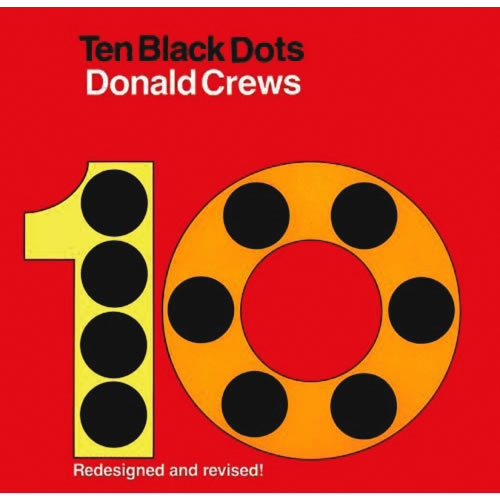
The Ten Black Dots, Donald Crews a book about all the different things you can do with ten black circles Posted by Dilmer Carrasco

The Ten Black Dots Dilmer Carrasco Posted by Dilmer Carrasco Author Donald Crews Recommended grade level: Kindergarten CCSSM Standa...