Tuesday, October 2, 2018

The Greedy Triangle by Jeremy Perez


Image result for the greedy triangle
 
Title: The Greedy Triangle
Author:
Marilyn Burns
Illustrator: Gordon Silveria
Recommended Grade Level:
PreK-2nd


CCSSM Content Standards:

CCSS.Math.Content.2.G.A.1
Recognize and draw shapes having specified attributes, such as a given number of angles or a given number of equal faces.1 Identify triangles, quadrilaterals, pentagons, hexagons, and cubes.


CCSSM Mathematical Practice:


CCSS.Math.Practice.MP5 Use appropriate tools strategically. Mathematically proficient students consider the available tools when solving a mathematical problem. These tools might include pencil and paper, concrete models, a ruler, a protractor, a calculator, a spreadsheet, a computer algebra system, a statistical package, or dynamic geometry software.SM Standard for


Summary
: There once was a triangle who grew tired of his shape, angles and sides. He decided he wanted to be made into a new shape so he went to the shapeshifter who kept making him into all kinds of new shapes and sides. What once was a triangle has now become a decagon who could no longer recognize himself because of how greedy he was.


Rating: *****
I give this book five stars because it is a colorful child friendly book, which illustrates everyday items and taps into a child’s experience to explain different types of polygons. It starts with a simple triangle and increases by one angle and side to continue to teach and give examples of each shape.

Classroom Ideas/Lesson Ideas: I plan to use this book to introduce polygons starting with triangles. I will introduce the total number of sides and angles it has. From there I will discuss each new polygon as I increase each shape by a side and an angle. The students will then be able to learn about triangles, quadrilateral, pentagon, hexagon, heptagon, octagon, nonagon, and decagon.
Title: The ICKY BUG Counting Book
Author: Jerry Pallotta
Illustrator: Ralph Masiello
Recommended Grade Level: 2

Common Core Mathematics Standard:
CCSS.MATH.CONTENT.2.OA.B.2
Fluently add and subtract within 20 using mental strategies. By end of Grade 2, know from memory all sums of two one-digit numbers.
CCSS.MATH.CONTENT.2.OA.C.3
Determine whether a group of objects (up to 20) has an odd or even number of members, e.g., by pairing objects or counting them by 2s; write an equation to express an even number as a sum of two equal addends.
CCSS.MATH.CONTENT.2.OA.A.1
Use addition and subtraction within 100 to solve one- and two-step word problems involving situations of adding to, taking from, putting together, taking apart, and comparing, with unknowns in all positions, e.g., by using drawings and equations with a symbol for the unknown number to represent the problem.1


Common Core Standards for Mathematical Practice:
CCSS MATH PRACTICE MP4 Model with mathematics.

Summary:  This book highlights species of bugs and insects page by page totaling up to 26. Interestingly, the book begins with the number 0. Each page vibrantly illustrates either a number of bugs or insects and a brief description about the selected species, as the story progresses the number of the selected insect or bug increase.

Rating:  ***** This book is a great book to expose students to nature, while also having a mathematical concept in mind. Students will learn about bugs and insects while also counting along as a class and individually. It can be used to reinforce knowledge in various subjects. As per math it serves as a tool to help students count, add, subtract etc.

Classroom Ideas: 
Students could be paired into groups of bugs or insects and work together in solving addition and subtraction problems. It is also great for grouping strategies.
Example:
-       Students will be asked if your group was the eight bright stinkbugs and ten of the caterpillars group wants to join your group how many will you be in total?
This example could be reversed and used as a subtractive strategy.


Curious George Saves His Pennies by Lauren Owen


Title: Curious George Saves His Pennies
Author: Monica Perez
Illustrator: Mary O’Keefe Young
Recommended Grade Level: 2

Common Core Mathematics Standard:
  1. CCSS.MATH.CONTENT.2.MD.C.8
    Solve word problems involving dollar bills, quarters, dimes, nickels, and pennies, using $ and ¢ symbols appropriately. Example: If you have 2 dimes and 3 pennies, how many cents do you have?
Use addition and subtraction within 100 to solve one- and two-step word problems involving situations of adding to, taking from, putting together, taking apart, and comparing, with unknowns in all positions, e.g., by using drawings and equations with a symbol for the unknown number to represent the problem.
Common Core Standards for Mathematical Practice: CCSS.MATH.PRACTICE.MP4 Model with mathematics.

Summary: This story is about a monkey, Curious George, who goes to a toy store and finds a red train that he wants to buy. His friend, the man in the yellow hat, tells him that the train is $5.00 and if he saves up his money he can buy the train. George looks in his piggy bank and counts the amount of money he has, to get more money George needs to look for money in his house and get a job to save $5.00. Overtime George works many jobs and makes $5.00 but looses his piggy bank. He goes to the toy store and sees that a little girl returned his piggy bank and he is able to buy the red train with his hard earned money.

Rating: **** I recommend this book as it has several important mathematical connections for students. The story provides a real-life mathematical situation where students learn how to make, recognize, and count money.

Classroom Ideas: This book could be used with teaching students money. Students could use money manipulatives to act out buying something from a store. Students could use money manipulatives to learn the values of each coin. Students could also “work” for money doing jobs in the classroom that earn them money that they have to count at the end of each day. Students could keep come up with different combinations of coins to get a value. Students could also use addition and subtraction to find out how much money George needs to get to $5.00.


Pete the Cat and His Four Groovy Buttons By: Ezamina Alibasic

Pete the Cat and His Four Groovy Buttons By: Ezamina Alibasic


Story by Eric Litwin

Art by James Dean ( creator of Pete the Cat)

Recommended Grade Level: Pre K-2

CCSSM Content Standards: 
CCSS.MATH.CONTENT.1.OA.A.1 Use addition and subtraction within 20 to solve word problems involving situations of adding to, taking from, putting together, taking apart, and comparing, with unknowns in all positions, e.g., by using objects, drawings, and equations with a symbol for the unknown number to represent the problem.1


CCSSM Standard for Mathematical Practice: 

CCSS.MATH.PRACTICE.MP4  Model with mathematics.
Mathematically proficient students can apply the mathematics they know to solve problems arising in everyday life, society, and the workplace. In early grades, this might be as simple as writing an addition equation to describe a situation.

Summary: Pete the Cat and his Four Groovy Buttons is about a cat who lost his buttons each day. Pete the Cat doesn’t let it phase him, as each time he loses a button he states that he still has another button and remains positive throughout the story. Finally, Pete the Cat loses his last button but still looks at the bright side and exclaims that he still has his belly button.


Pete the Cat and His Four Groovy Buttons incorporates mathematics, sequencing of events, repetition and could be made a sing-a-long.

Rating (1-5 Stars) 5 I highly recommend this book as it is fun to read and easy to memorize. There are several site words that would be helpful for the student to utilize in more than one subject. It is also very clear on how a subtraction problem is set up which will familiarize the younger kids with what that will look like for them when they begin to work with subtraction.


Classroom Ideas/Lesson Ideas:

~Subtraction Stories. After reading Pete the Cat and His Four Groovy Buttons, have the students tell their own subtraction stories. Younger students can use manipulatives, such as teddy bear counters, to tell a story (e.g., “4 bears were playing. 1 went home. 3 were still playing”). Older students can illustrate their stories, adding words and/or a number sentence to match. Then pair students to share their subtraction stories. Each student should try to solve his/her partner’s subtraction problem.
~Button Counting, Graphing, and Sorting activity.
  • color hues – the buttons varying only in color can be sorted and classified by color.
  • sizing – the buttons varying only in size can be sorted and classified from smallest to largest or vice versa.
  • different/same – the buttons varying in size & color can be sorted and classified by their sameness & differences.
  • counting – by added a number card, they are learning the visual recognition of the number in words (the number card) & then counting it out in a tangible object (the buttons), therefore assimilating the two together (great for all your visual learners!)
  • symmetry – by lining up the buttons on the dots they are creating symmetry – symmetry in color, size, or shape. 
~ Creating a Pete the Cat and His Four Groovy Buttons story retelling cards. These cards are a great way to practice retelling familiar stories and place events in order. They can be used in large group or small group and there are extra word cards to encourage children to draw a picture of their favorite part and label it. The retelling cards helps with sequencing.

Monday, October 1, 2018


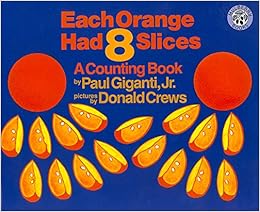
Image result for each orange had 8 slicesEach Orange Had 8 Slices BY Brigjilda Kola

Author: Paul Giganti, Jr.
Illustrator: Donald Crews
Recommended Grade Level: 3rd Grade
CCSSM Content Standards:
CCSS.MATH.CONTENT.3.OA.A.1
Interpret products of whole numbers, e.g., interpret 5 × 7 as the total number of objects in 5 groups of 7 objects each. For example, describe a context in which a total number of objects can be expressed as 5 × 7.

CCSS.MATH.CONTENT.3.OA.A.3
Use multiplication and division within 100 to solve word problems in situations involving equal groups, arrays, and measurement quantities, e.g., by using drawings and equations with a symbol for the unknown number to represent the problem.1

Standards for Mathematical Practice:

CCSS.MATH.PRACTICE.MP1 Make sense of problems and persevere in solving them.


Summary- Each Orange Had 8 Slices is a counting book that uses words and visuals to introduce the math concept of multiplying and adding up. It’s a book that simplifies multiplying, adding, and counting their way through the math puzzles hiding in the world all around us.

Rating-***** this is a great book to introduce multiplication to third graders using grouping as well as reiterate that multiplication is repeated addition. It’s also great for problem solving a number sentences as it gives the reader the same 3 questions to help break down the answer to the problem.

Classroom Ideas/Lesson Ideas:

Students can be paired up with a partner to solve the rest of the problems mentioned in the book using manipulatives. The purpose of the lesson is to get students comfortable to read number problems with multiplication and use that information to get to their answer. Students will then make their own page for a class book by writing their own multiplication number stories. Each page must include illustrations, statements that relate to the illustrations, and questions related to the illustrations.

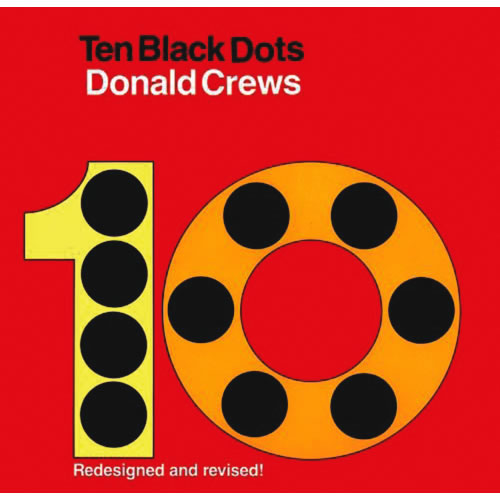
The Ten Black Dots, Donald Crews a book about all the different things you can do with ten black circles Posted by Dilmer Carrasco

The Ten Black Dots Dilmer Carrasco Posted by Dilmer Carrasco Author Donald Crews Recommended grade level: Kindergarten CCSSM Standa...