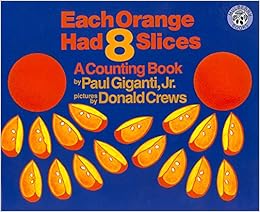
 Each Orange Had 8 Slices BY Brigjilda Kola
Author: Paul Giganti, Jr.
CCSS.MATH.CONTENT.3.OA.A.1
Interpret products of whole numbers, e.g., interpret 5 × 7 as the total number of objects in 5 groups of 7 objects each. For example, describe a context in which a total number of objects can be expressed as 5 × 7.
Interpret products of whole numbers, e.g., interpret 5 × 7 as the total number of objects in 5 groups of 7 objects each. For example, describe a context in which a total number of objects can be expressed as 5 × 7.
CCSS.MATH.CONTENT.3.OA.A.3
Use multiplication and division within 100 to solve word problems in situations involving equal groups, arrays, and measurement quantities, e.g., by using drawings and equations with a symbol for the unknown number to represent the problem.1
Use multiplication and division within 100 to solve word problems in situations involving equal groups, arrays, and measurement quantities, e.g., by using drawings and equations with a symbol for the unknown number to represent the problem.1
Standards for Mathematical Practice:
CCSS.MATH.PRACTICE.MP1 Make sense of problems and persevere
in solving them.
Summary- Each Orange Had 8 Slices is a counting
book that uses words and visuals to introduce the math concept of multiplying
and adding up. It’s a book that simplifies multiplying, adding, and counting their
way through the math puzzles hiding in the world all around us.
Rating-***** this is a
great book to introduce multiplication to third graders using grouping as well
as reiterate that multiplication is repeated addition. It’s also great for
problem solving a number sentences as it gives the reader the same 3 questions
to help break down the answer to the problem.
Classroom Ideas/Lesson Ideas:
Students can
be paired up with a partner to solve the rest of the problems mentioned in the
book using manipulatives. The purpose of the lesson is to get students
comfortable to read number problems with multiplication and use that
information to get to their answer. Students will then make their own page for
a class book by writing their own multiplication number stories. Each page must include illustrations, statements that
relate to the illustrations, and questions related to the illustrations.



I love how this book lets you learn by grouping of the numbers which could tie into using manipulatives for the students to be able to work the number groupings kinesthetically. This enables them to see how the problem is put together.
ReplyDeleteMultiplication is so important to understanding algebra. Students can benefit greatly from understanding equivalents and seeing the relationship of addition and subtraction. If they can begin to see the relationship they can use the same skills to understand how other mathematical concepts work.
ReplyDelete